
A family office, an RIA, and an institutional allocator may all appear on a private credit prospect list. Those labels tell you something about the organization. They tell you much less about whether the strategy fits its mandate or how an allocation decision gets made.
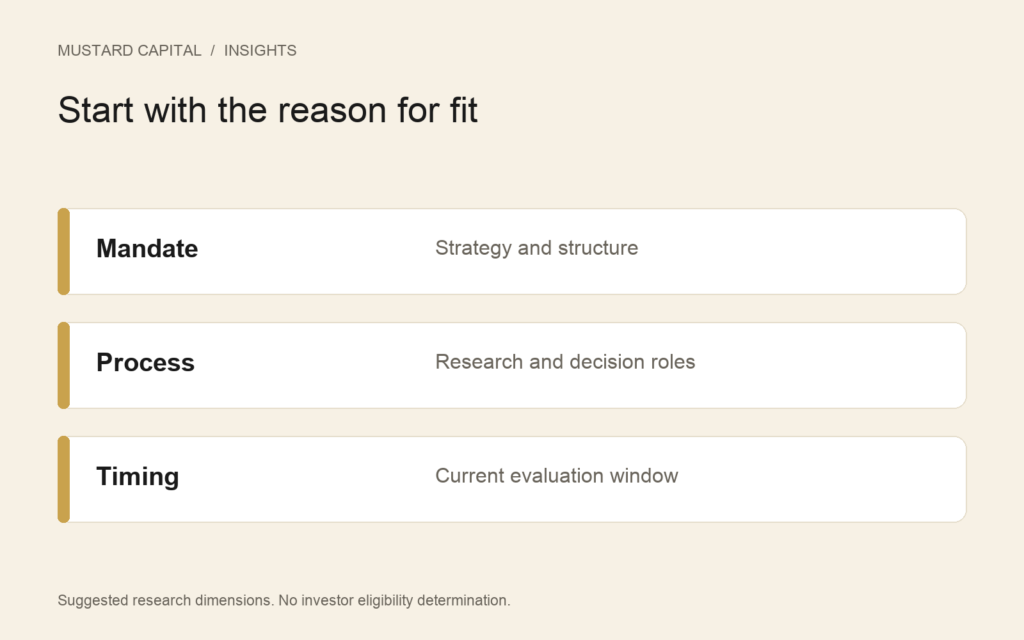
Private credit allocator segmentation should give the fundraising team a reason for each conversation. Start with the investment mandate and evaluation process, then decide which message and materials belong in the first outreach.
Separate firm type from strategy fit
Two organizations with the same label can have very different interests. One may evaluate a specific lending strategy; another may have no current mandate for it. Avoid filling those gaps with assumptions about how an entire investor category behaves.
For each relationship, record what you know, where the information came from, and when it was checked. If a public profile is broad or dated, mark the fit as unconfirmed. The first conversation can resolve that uncertainty.
| Dimension | Question to resolve | Evidence to record |
|---|---|---|
| Mandate | Does the allocator evaluate this credit strategy? | Current mandate or direct confirmation |
| Vehicle and access | Can the allocator evaluate this structure? | Confirmed requirements and open questions |
| Decision process | Who researches, recommends, and approves? | Roles confirmed through the relationship |
| Evaluation timing | Is there an active review window? | Date and source of the timing information |
| Diligence priorities | Which questions are likely to shape evaluation? | Specific requests or stated criteria |
Keep suitability, eligibility, and legal determinations with the appropriate professionals. An outreach segment is an operating tool. It is not a conclusion that a recipient can or should invest.
Choose the next action from the evidence
A simple routing process is often more useful than a score with ten weighted inputs. The question is whether the team has enough information to take a relevant next step.
| Relationship state | Next action |
|---|---|
| Fit is plausible but not confirmed | Ask a focused mandate question |
| Fit is confirmed; timing is unclear | Clarify the evaluation window |
| Fit and timing are confirmed | Offer a relevant introduction and approved materials |
| Investor is evaluating the manager | Assign an IR owner and track diligence questions |
| Strategy is outside the stated mandate | Record the reason and stop the current campaign |
This framework is a suggested workflow, not an industry benchmark. It gives the team a way to distinguish a research task from an active investor conversation. Review segment assignments when new evidence arrives rather than treating the original list as permanent.
Change the message before changing the volume
A relevant message explains why the specific strategy belongs in the recipient’s research process. If the team cannot explain that connection in a few plain sentences, more outreach is unlikely to resolve the missing information.
For a contact exploring the category, the useful next step may be an approved overview of the strategy and process. For a contact already evaluating the manager, it may be an answer to a specific underwriting, governance, or reporting question. Do not send the same material simply because both contacts sit in the same CRM stage.
ILPA’s due diligence questionnaire offers a broader reference for manager-evaluation questions. It was developed in a private-markets context and should be adapted thoughtfully; it is not a substitute for a private credit investor’s own diligence requirements.
Keep research uncertainty visible in the CRM
Use separate fields for confirmed facts and working hypotheses. A note such as “may evaluate asset-backed lending; confirm on introduction” is more useful than an unsupported “high fit” label. Include a source and date so the next team member knows what still needs checking.
Limit access to sensitive relationship information and avoid putting personal financial details into broad marketing segments. Collect only what the team needs for the appropriate stage and approved workflow.
Review the segments after the first conversations
Compare replies and qualified conversations by segment. Look for repeated reasons that an opportunity does not fit, questions that slow evaluation, and missing information that prevents a next step. Those observations can improve targeting and materials before the campaign expands.
The goal is a list that helps the IR team act with context. For the measures that can support that review, see investor pipeline metrics beyond lead volume. For materials readiness, use the investor data room checklist.
Explore Mustard’s services or speak with the team about coordinating investor research, demand generation, and follow-up.
Sources and further reading
- ILPA Due Diligence Questionnaire. A reference for the questions investors ask when evaluating a manager. It does not establish pipeline conversion benchmarks.
The operating frameworks and hypothetical examples above are editorial analysis, not client results, industry benchmarks, or investment advice.