
A campaign can produce a busy inbox without producing a useful investor pipeline. The gap usually appears after the first response: the strategy does not fit, the timing is wrong, or the next step never becomes clear.
For a fund manager or sponsor, the useful question is what happened to the relationships the campaign introduced. A small scorecard can answer that question without turning the weekly fundraising meeting into a review of every marketing metric.
Define a qualified relationship before counting one
A downloaded deck signals interest. It does not establish mandate fit, decision authority, or a realistic evaluation timeline. Write a qualification definition that the marketing and IR teams can both apply. At minimum, record the reason the strategy may fit, the contact’s role, the source of that information, and the agreed next action.
Leave uncertain fields marked as unknown. A record should not become qualified simply because somebody filled in every field. Nor should an unverified assumption about an investor’s financial capacity be treated as a fact.
Use a small set of investor pipeline metrics
| Metric | How to calculate it | What to investigate |
|---|---|---|
| Fit-confirmed rate | Relationships meeting your definition / new unique relationships | Targeting, positioning, or incomplete qualification |
| Held-meeting rate | Relationships with a completed first meeting / fit-confirmed relationships | Scheduling friction or weak next steps |
| Diligence progression | Relationships beginning an agreed diligence process / relationships with held meetings | Readiness of materials and unresolved questions |
| Next-action coverage | Active relationships with an owner and dated action / active relationships | Follow-up responsibility |
| Time in stage | Days since the most recent stage entry | Stalled decisions, missing documents, or poor timing |
Keep the denominator visible. A meeting rate calculated from all inquiries answers a different question from a meeting rate calculated from qualified relationships. Count unique relationships consistently, and decide how multiple contacts at one institution roll up to the same account.
Compare channels on the same basis
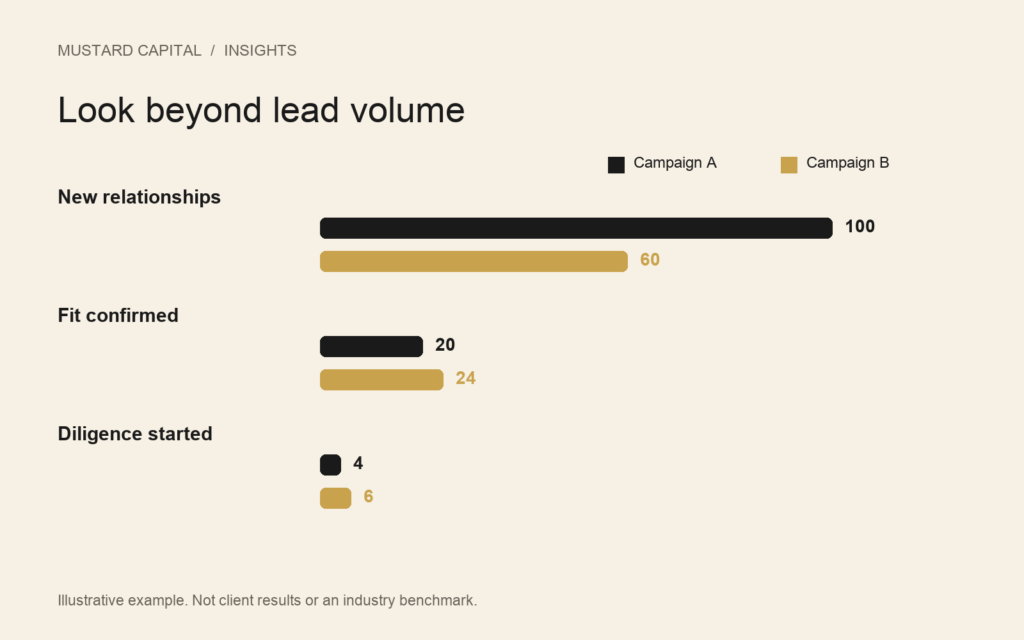
Consider two hypothetical campaigns reviewed after the same follow-up period. Campaign A produces more inquiries, while Campaign B produces more relationships that meet the team’s fit definition.
| Outcome | Campaign A | Campaign B |
|---|---|---|
| New relationships | 100 | 60 |
| Fit confirmed | 20 | 24 |
| First meetings held | 10 | 12 |
| Diligence started | 4 | 6 |
| Fit-confirmed rate | 20% | 40% |
Campaign B deserves a closer look, but the table does not prove it is the better investment. The team still needs acquisition effort, campaign expenditure, audience differences, and enough observation time to compare the cohorts fairly. Six diligence starts also tell you nothing certain about eventual commitments.
Compare relationships introduced during a defined period and give both cohorts the same time to progress. Report newer cohorts separately. Otherwise, an older campaign can look stronger simply because its relationships have had more time to develop.
Connect marketing attribution to the IR record
Google Analytics documents how campaign tags identify traffic source, medium, and campaign. That helps explain how a visitor arrived. It does not establish why an allocator took a meeting or decided to evaluate the opportunity.
Preserve campaign attribution in the CRM when appropriate, alongside the source reported by the investor. Keep original source and later touchpoints separate. A referral may arrive through a search visit; overwriting the referral with the final click removes useful context. Keep personal details out of campaign URLs.
Turn the scorecard into decisions
Review the exceptions each week. If fit is weak, revisit the audience and message. If qualified contacts do not reach meetings, inspect the handoff. If meetings stall before diligence, ask which questions or materials are missing. A stage-change note should explain the evidence behind the change.
ILPA’s due diligence questionnaire provides context for the depth of manager evaluation. It is a reminder that movement toward diligence needs substance behind it. A click or calendar invitation should not be presented as equivalent to that work.
For the stage definitions behind this scorecard, see our guide to building a private equity investor pipeline. Mustard’s investor acquisition approach connects targeting, demand generation, and follow-up.
Sources and further reading
- Google Analytics: traffic-source dimensions. Official guidance on manual campaign tagging and attribution dimensions.
- ILPA Due Diligence Questionnaire. A reference for the questions investors ask when evaluating a manager. It does not establish pipeline conversion benchmarks.
The operating frameworks and hypothetical examples above are editorial analysis, not client results, industry benchmarks, or investment advice.