
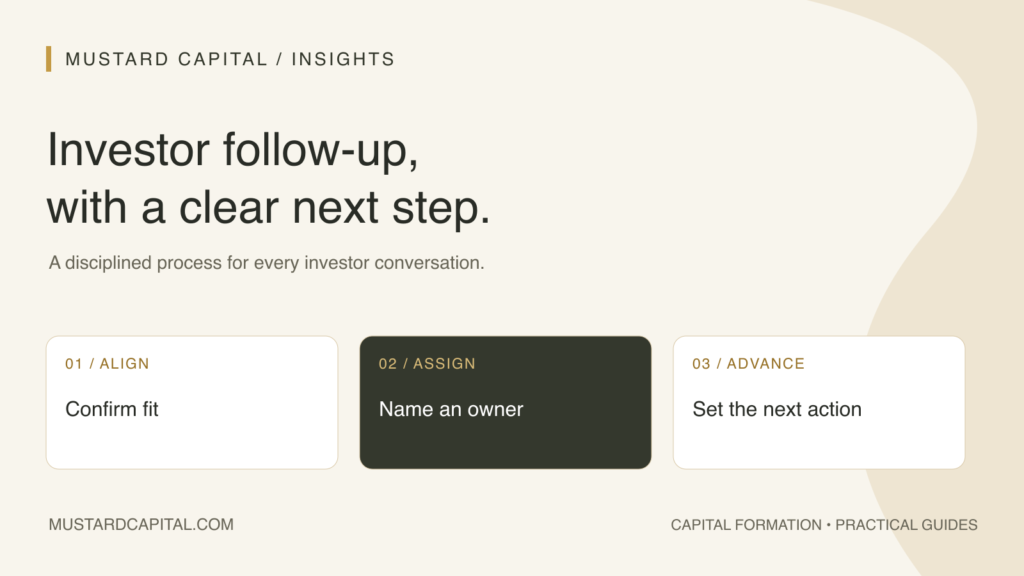
A useful investor follow-up plan assigns every active conversation an owner, a specific next action and a date. Build that process before outreach begins. Otherwise, a growing list of replies can hide a much smaller number of relationships that are actually progressing.
For a fund manager or sponsor, the goal is to make the next decision easier for both sides. An investor should know what you will provide, why it matters and what happens afterward. Your team should be able to explain the same sequence without searching several inboxes.
Start With the Decision, Then Write the Follow-Up
“Send more information” is too broad to manage. Does the investor need to decide whether the strategy fits its mandate, whether to take a first meeting or whether to begin diligence? Each decision calls for a different response.
Before a campaign starts, map the few decisions that matter to your process. Write down the approved material that supports each one. A short strategy brief may be appropriate for an initial fit discussion. A detailed operating document belongs later, after the team has confirmed the recipient and the appropriate level of access.
Investors also have their own evaluation process. The ILPA Due Diligence Questionnaire is a useful reference for organizing manager diligence questions. It is not a follow-up script or a universal list of documents every recipient should receive.
Use One Record for Each Investor Relationship
Your CRM record should make the current situation clear to someone who did not attend the last call. Keep the facts separate from the team’s interpretation. “Requested the operating overview” is a fact. “Likely to invest” is an assumption unless the investor has actually said something that supports it.
| Field | What to Record | Why It Helps |
|---|---|---|
| Current Decision | Mandate fit, first meeting or diligence review | Keeps the next message relevant |
| Relationship Owner | One accountable person | Prevents competing replies |
| Next Action | A concrete deliverable or question | Turns a status into work |
| Agreed Timing | A date or investor-requested review window | Avoids an arbitrary sequence |
| Open Question | The information still needed for the decision | Guides the next conversation |
| Approved Material | Document name, version and access level | Reduces inconsistent answers |
Keep meeting notes concise enough to use. A long transcript may be valuable context, but the relationship owner still needs a short, accurate action record.
Choose Timing Based on the Conversation
There is no single interval that fits every investor. If someone asks for an update after an internal review, record that window. If the next step depends on your team supplying a document, complete that task first. If no timing was agreed, ask a clear question instead of sending repeated “checking in” messages.
For example, an investor might request a strategy overview before deciding whether to schedule a meeting. The follow-up could confirm that request, provide the approved overview and ask whether the investor would prefer a discussion now or after reviewing it. This is an illustrative operating example, not a promise that a particular message will convert.
Respect a decline or a request to stop. Separate a deferred relationship from an active one so that an investor who is waiting for a future allocation window does not receive the same reminders as someone in current diligence.
Prepare the Handoff Between Outreach and Diligence
As the questions become more detailed, the relationship owner may need help from operations, finance or another specialist. Decide who can answer each category before those questions arrive. Include a review step for sensitive or regulated statements, and give the relationship owner responsibility for returning the approved response.
A simple sequence is: record the question, assign an answer owner, confirm the approved response, then close the loop with the investor. Keep a link to that response so the next person does not recreate it from memory. Our Investor Data Room Checklist provides a starting point for organizing supporting materials.
Review the Work That Has Stalled
In a weekly review, look for active relationships with no next action, overdue items, unanswered diligence questions and records whose status has not changed for a meaningful reason. Discuss the decision needed to move each record forward, defer it or close it.
A team can send more messages while leaving these problems unresolved. Track completed next actions and stage progression alongside activity volume. The Investor Pipeline Metrics Guide explains how to keep those measures tied to consistent definitions and cohorts.
Build the Plan Before Adding More Volume
Start with a small set of current relationships and check whether another team member can understand each record. Fix unclear ownership, missing materials and vague next steps before expanding outreach. The Investor Pipeline Workbook can help document that review.
This is an operating framework, not guidance on which offering exemption or solicitation method to use. The SEC’s Capital-Raising Building Blocks provides general educational resources on offering pathways and related topics. Have qualified counsel review the communications approach for your circumstances.
Sources and Editorial Notes
References reviewed October 13, 2026: ILPA Due Diligence Questionnaire resource page and SEC Capital-Raising Building Blocks. The workflow, table and example are Mustard Capital editorial analysis. They are not client results, conversion benchmarks or a guarantee of fundraising outcomes.