
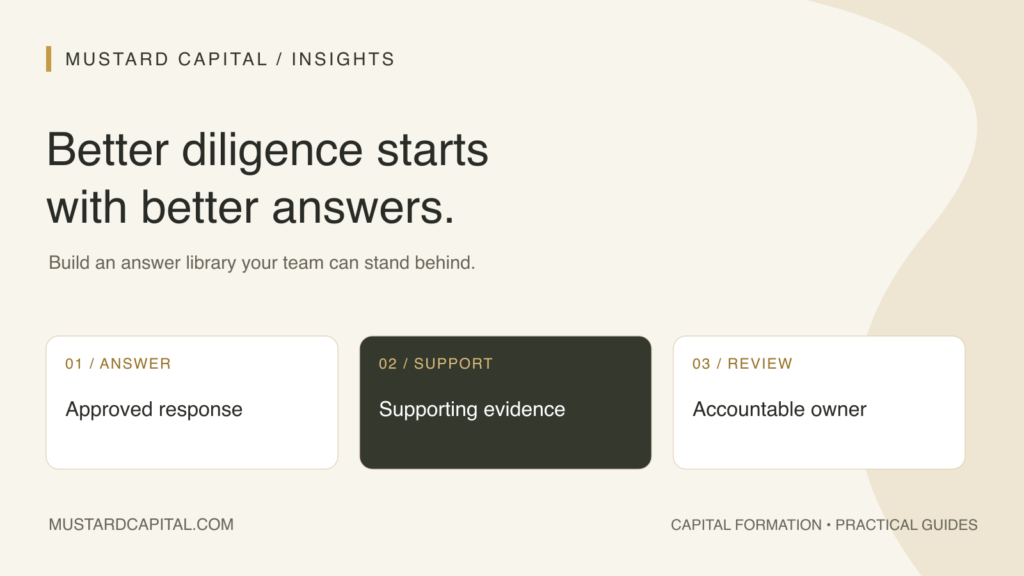
A useful investor due diligence questionnaire starts with an answer library: approved responses, named owners and links to supporting evidence. For a private fund manager, that library should explain how the firm actually operates. Build it before the next allocator request arrives, then adapt each response to the question being asked.
The hard part is rarely finding a blank questionnaire. It is making sure the investment team, operations team and investor relations team tell the same story. A polished answer loses value when the supporting document says something different or nobody can explain when the response was last reviewed.
What Is an Investor DDQ?
A due diligence questionnaire, or DDQ, helps an investor collect structured information about a manager. ILPA describes its questionnaire as a way to standardize key areas of investor inquiry. Its resource page provides the DDQ 2.0 and related guidance. That is a useful starting reference, rather than proof that one completed document will satisfy every allocator. Source: ILPA Due Diligence Questionnaire.
An answer library serves a different purpose. It is your internal record of what the team can support today. An investor may use its own questionnaire, ask for a conversation or request additional evidence. The library helps your team respond consistently across those formats without treating every new request as a writing project.
Separate the Answer From the Evidence
Give each entry a short answer, a source document, a responsible owner and a review date. Keep a separate field for limitations. If a process is planned but not implemented, say so. If a response applies only to one vehicle, identify that vehicle instead of allowing the statement to become a firmwide claim.
Do not paste confidential records into a broadly accessible worksheet. Store references to restricted documents and manage access in the underlying repository. The library tells the team where evidence lives; it does not need to become another uncontrolled copy of the data room.
| Question Area | Answer Owner | Evidence to Locate | Review Trigger |
|---|---|---|---|
| Investment decision process | Investment lead | Current committee process and approval record | Change in decision authority |
| Team responsibilities | Operations lead | Dated organization chart and role descriptions | Hiring, departure or reassignment |
| Investor reporting | Investor relations lead | Approved sample report and delivery process | Reporting format or timing changes |
| Document access | Data room administrator | Access procedure and permission register | New provider or access policy |
Use your actual role titles. In a small team, one person may own several areas. What matters is that the reviewer knows who can confirm the answer and who can approve its release. Pair this worksheet with the Investor Data Room Checklist to connect responses with the right supporting files.
Write Responses That Survive a Follow-Up Question
Replace broad assurances with observable steps. “We have a rigorous process” leaves the reader guessing. A more useful response identifies who prepares a recommendation, who reviews it, how a decision is recorded and where exceptions are handled. Only include those details when they describe the process your team actually follows.
ILPA’s Principles emphasize alignment of interest, governance and transparency. Those themes provide context for reviewing whether an answer is useful, but they do not certify a manager’s processes. The workflow proposed here is an editorial recommendation, not an ILPA template or endorsement. Source: ILPA Principles.
For example, imagine an allocator asks who reviews investor reports before distribution. The draft answer says “the leadership team.” Before sending it, ask which role checks the figures, which role reviews the narrative and who authorizes release. If the team cannot answer those questions, the next task is resolving the process, not strengthening the adjective.
Run a Consistency Review Before Sharing
Compare the draft questionnaire with the deck, website, sample reports and relevant supporting documents. Check team names, strategy descriptions, dates and definitions. When two documents disagree, resolve the underlying fact before editing the language. Keep a record of what changed and which materials need updating.
Maintain both an approved internal version and the exact version shared with each investor. Record the recipient, date and any tailored responses. This makes a later follow-up easier to interpret and helps prevent an outdated response from being copied into a new conversation. Your Investor Pipeline Metrics can track outstanding diligence requests without treating questionnaire completion as an investment commitment.
Start With the Questions Already Slowing You Down
Choose a small group of recurring questions from recent conversations. Assign owners, locate evidence and mark each response as draft, approved or needing an update. Review unresolved items together before expanding the library. A shorter set of reliable answers is more useful than a complete-looking document full of assumptions.
Which question currently requires the most back-and-forth inside your team? Start there. The objective is a repeatable response process that makes your next investor conversation clearer, while leaving room for the allocator’s specific diligence needs.