
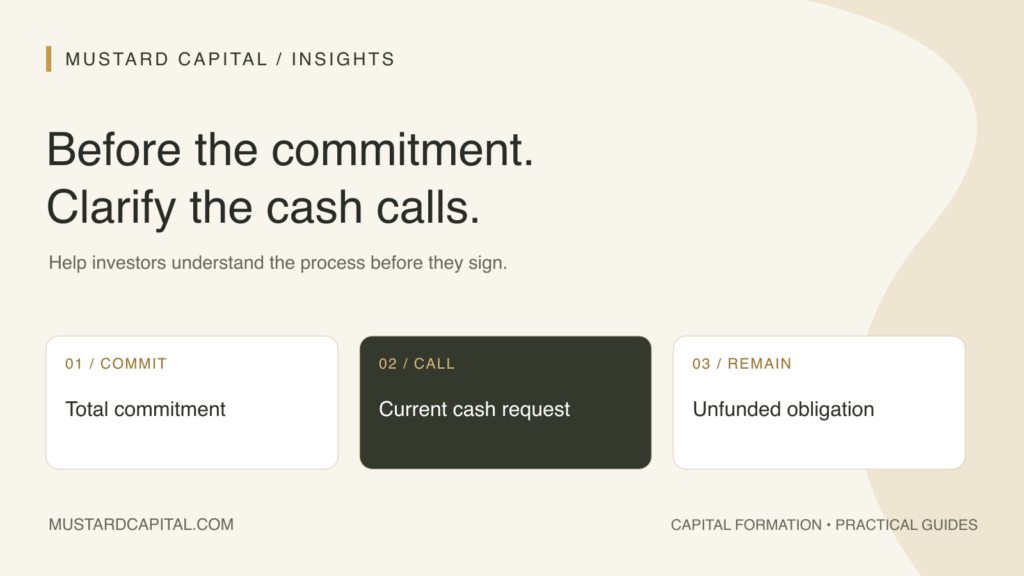
Before asking an investor to commit to a private fund, explain how that commitment becomes a cash obligation. A clear capital call conversation should distinguish the amount committed, the capital requested today, the remaining obligation and the uncertainty around future timing. Our recommendation is to make this explanation part of fundraising preparation, rather than leaving it entirely to onboarding.
This is especially useful when a manager is introducing a strategy to investors who understand the investment thesis but have less experience with closed-end fund mechanics. A polished deck can generate interest. A practical explanation of cash requirements helps an investor decide whether the structure fits their circumstances.
Start with the structure, not a forecast
The SEC’s private equity investor guide highlights illiquidity, withdrawal restrictions, and the importance of offering documents and agreements in governing investment terms. These considerations belong near the beginning of an investor conversation, not only in a closing checklist.
Describe the actual vehicle being offered. Do not use an explanation written for a drawdown fund when the offering requires all capital at subscription. Likewise, do not describe a closed-end vehicle using language that suggests investors can redeem whenever they choose. Ask counsel and the administrator to review the explanation against the governing documents before it becomes reusable marketing material.
Use four separate labels
In a simple hypothetical example, an investor commits $1 million and receives an initial call for $200,000. If there are no other adjustments, $800,000 remains unfunded. That arithmetic does not mean the remaining amount will be called evenly, that the first call is the investor’s maximum exposure, or that distributions will arrive before another call.
Keep the explanation anchored to four labels: total commitment, current call, remaining unfunded commitment and expected timing. Show any forecast as an assumption, with its date and limitations. Explain how actual notices and governing terms take precedence over an illustrative presentation. Avoid placing estimated distributions beside required contributions in a way that makes uncertain incoming cash look guaranteed.
Build a short investor conversation guide
The following is a suggested discussion framework, not a substitute for offering documents or a prescribed industry standard. It can help the fundraising team identify questions that need a precise answer from fund operations.
| Investor question | What to prepare |
|---|---|
| What am I committing to? | The commitment structure and controlling document references. |
| When might cash be needed? | The notice process, applicable deadlines and clearly labelled assumptions. |
| What changes my remaining obligation? | An administrator-reviewed explanation of relevant adjustments. |
| Who handles questions? | A named operations contact and a secure communication process. |
Use the guide to surface uncertainty, not to talk an investor past it. An investor who needs predictable near-term liquidity may be identifying a genuine mismatch. Record the question and route it to the right person. A fundraising colleague should not improvise exceptions, suggest a missed call has no consequences, or interpret legal remedies without appropriate review.
Connect the explanation to actual reporting
ILPA’s September 2025 Capital Call & Distribution Template guidance describes a framework for communicating transaction details and their effect on an investor’s unfunded commitment. It includes current and cumulative information and a dedicated unfunded commitment section. It is an industry reporting resource, not a promise about a particular fund’s cash flows.
For fundraising preparation, the useful lesson is consistency. Ask the administrator for a redacted or fictional sample notice suitable for educational use. Check that the labels in your presentation match the terminology investors will encounter later. Remove bank details, personal information and anything confidential. A sample should explain the process without becoming a payment instruction.
Make handoffs visible inside your team
Assign ownership before outreach begins. The fundraising team can explain approved materials and capture questions. Fund operations can clarify notice delivery and reporting procedures. Counsel can address document interpretation. Establish who approves revisions and where the current explanation is stored so an old attachment does not become the default answer.
Include these materials in your investor data room preparation, with version dates and clear access controls. Record unresolved operational questions alongside the investor’s next step, rather than treating every request for clarification as an objection to overcome. This gives the next team member useful context without overstating the investor’s readiness.
Prepare for an informed decision
Our view is that investor acquisition works better when the materials help people understand both the opportunity and its operating requirements. Before the next campaign, review your commitment explanation, sample notice, document references and escalation contacts as one set. Use Mustard Capital’s capital formation materials and engagement services to support clearer communication, while keeping fund-specific terms and approvals with the appropriate professionals.
For general education only. This article is not investment, legal or tax advice, an offer of securities, or a recommendation of a fund. Fund terms vary; governing documents and qualified advisers should guide specific decisions. Illustrative amounts are not forecasts or investment recommendations.