
An investor asks for a current organization chart. One team member sends a slide from an older deck. Another points to a folder with three versions. The document exists, but the process has created a new question: which information can the investor rely on?
An investor data room should make the next diligence conversation easier. File volume is a poor measure of readiness. Clear ownership, consistent information, and a reliable response process matter more.
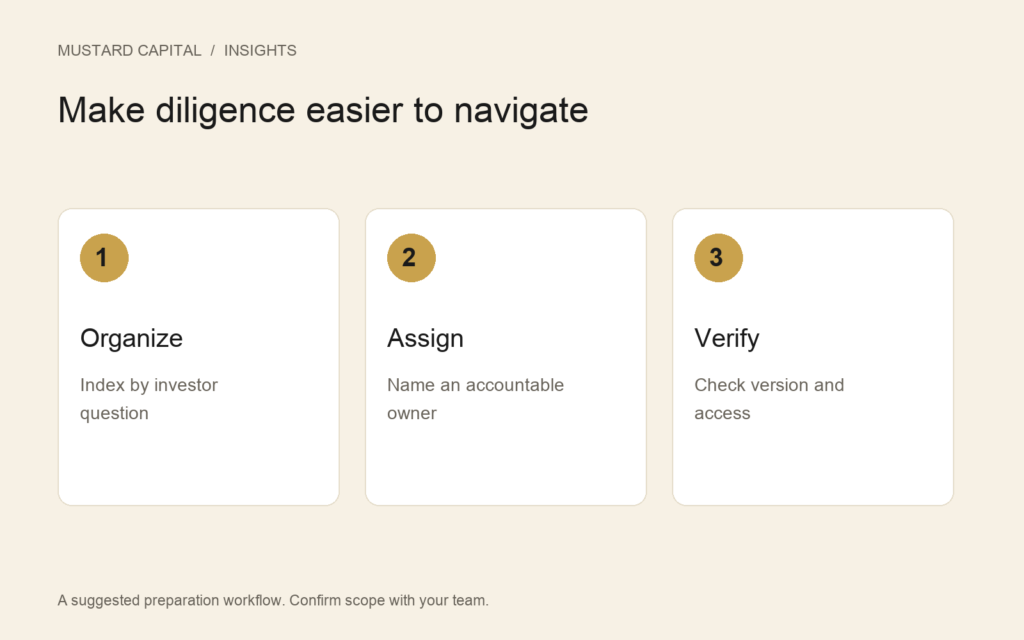
Build the index around investor questions
Use your expected diligence questions to organize the room. ILPA’s due diligence questionnaire is a useful reference for manager evaluation, although the exact materials needed will depend on the strategy, vehicle, investor, and counsel’s advice. Treat a questionnaire as a guide for preparation, not a claim that every investor requires the same package.
| Section | Examples to prepare | Readiness check |
|---|---|---|
| Firm and team | Organization chart, biographies, responsibilities | Names, roles, and dates agree across documents |
| Strategy and process | Investment approach, sourcing, decision process | Description matches the current offering materials |
| Portfolio and track record | Approved supporting information and methodology | Definitions, periods, and limitations are clear |
| Operations and governance | Service-provider information and relevant policies | Owner confirms the material is current and shareable |
| Reporting | Approved examples and reporting calendar | Investor can understand the proposed reporting process |
| Offering documents | Documents approved for the intended recipient | Counsel confirms version and access requirements |
The checklist is an operating starting point. It does not replace legal review or determine what a particular offering must disclose. Keep investor-specific or sensitive information out of general-access folders.
Assign a person to every section
Give each section one accountable owner and one review date. The owner does not need to author every document. They need to know whether it is current, who can approve an answer, and what should happen when a request falls outside the existing materials.
A small index can include document title, version date, responsible person, approval status, and access level. Avoid file names such as final-final-updated. Use a naming convention your team can apply without interpretation, and archive superseded versions away from the active investor view.
Test the room against a real question
Before inviting an allocator, have someone unfamiliar with the folder structure locate the answers to five likely questions. Record where they pause, find conflicting versions, or need to contact the team. That exercise exposes friction that a visual review of the folder list will miss.
For example, a hypothetical review of twelve planned documents might find eight current and approved, three awaiting updates, and one still missing. That is an internal readiness count, not a measure of investor confidence. Prioritize the gaps that block a specific diligence question instead of treating every unfinished document as equally urgent.
Run requests through one visible queue
| Field | Purpose |
|---|---|
| Investor question | Preserve the actual question, not an abbreviated guess |
| Owner and reviewer | Separate preparation from approval where needed |
| Due date | Give the team a clear response commitment |
| Response location | Link to the approved answer or document |
| Status and follow-up | Track what remains unresolved after delivery |
Distinguish a file view from an answered question. Analytics can help identify activity, but they do not tell you whether the investor understood the material. Ask what additional context would be useful and record the answer in the relationship history.
Show how reporting will work after the raise
Fundraising materials should be consistent with the reporting process the organization can actually support. ILPA released its updated Reporting Template in January 2025 as part of its quarterly reporting initiative. Where relevant, use established reporting references to discuss format and responsibilities with your administrator and investors.
Do not present an example report as a promised deliverable until the responsible team has confirmed it. A polished sample creates confusion if definitions, coverage, or delivery expectations change after onboarding.
Mustard’s investor acquisition services include materials and IR support. To connect the data room with relationship stages and follow-up, read our investor pipeline guide.
Sources and further reading
- ILPA Due Diligence Questionnaire. A reference for the questions investors ask when evaluating a manager. It does not establish pipeline conversion benchmarks.
- ILPA Reporting Template v2.0 guidance. Background on the template released in January 2025. Applicability should be assessed for the particular fund.
The operating frameworks and hypothetical examples above are editorial analysis, not client results, industry benchmarks, or investment advice.